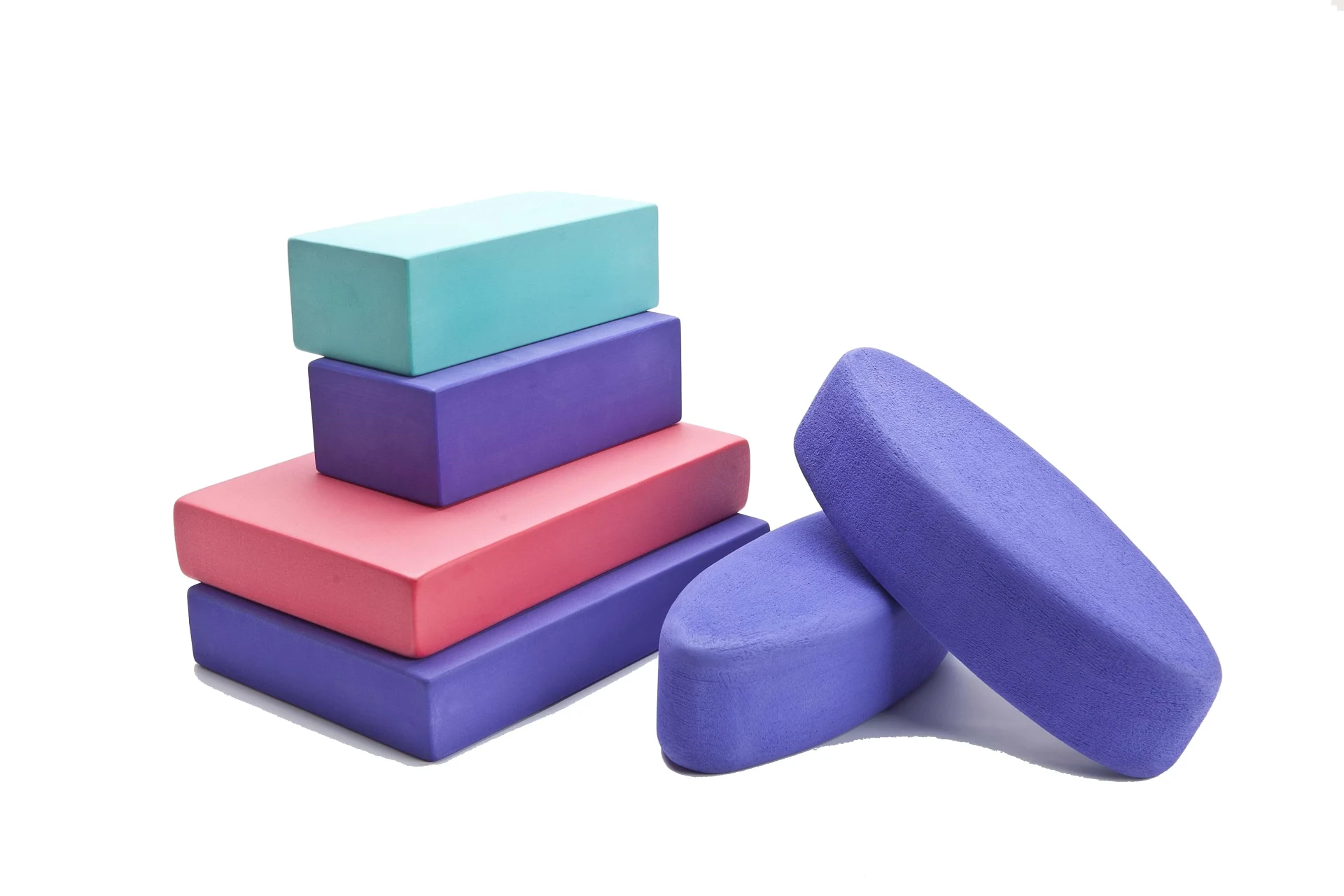
Choosing the right foam material is critical to the success of your product — whether you’re developing yoga equipment, protective packaging, or automotive components.
Both EVA foam and XLPE foam are closed-cell foams with overlapping characteristics, but they offer distinct properties that make them better suited for specific applications.
As a dual-site manufacturer operating in Vietnam and Taiwan, EVA FOAM Ind. provides both EVA and XLPE foam solutions, helping OEM partners worldwide select the right material for their projects.
Are Both EVA and XLPE Foams Crosslinked?
Yes — most EVA foam products used in commercial applications are also crosslinked.
There’s a common misconception that only XLPE foam is crosslinked. In reality, many EVA foam products are chemically or radiation crosslinked to improve mechanical performance, particularly in mid- to high-end applications.
While both materials benefit from crosslinking, their base polymers, internal structures, and physical behaviors differ significantly — which impacts their performance and end-use.
Key Differences Between EVA Foam and XLPE Foam
| Feature | Crosslinked EVA Foam | XLPE Foam (Crosslinked Polyethylene) |
| Base Material | Ethylene-Vinyl Acetate (EVA) | Polyethylene (PE) |
| Feel | Softer and more elastic | Firmer with structured rigidity |
| Rebound & Cushioning | Excellent shock absorption | High resilience, retains shape over time |
| Water/Chemical Resistance | Moderate | Excellent |
| Thermal Resistance | Up to 80–90°C | Up to 100–110°C |
| Surface Finish | Textured or embossed | Smooth, dense, premium finish |
| Cost | Lower to moderate | Generally higher |
| Typical Use Cases | Yoga mats, footwear, soft packaging, toys | Automotive interiors, insulation, precision packaging |
Performance at Higher Hardness Levels
At higher Shore hardness levels (e.g., 60C–70C), both EVA and XLPE foams become more rigid. However, their real-world performance starts to diverge:
- EVA foam, even when firm and crosslinked, maintains some elasticity. It’s ideal for applications needing comfort or light compression — but may deform under long-term pressure or weight.
- XLPE foam, by contrast, offers superior dimensional stability, compression resistance, and thermal performance. It’s a better fit for demanding structural, automotive, or insulating applications.
If your product requires long-term shape retention, exposure resistance, or mechanical durability, XLPE foam is the smarter choice.
Which Foam Should You Choose?
✓ Choose EVA foam when your product emphasizes:
- Comfort and flexibility
- Lightweight cushioning
- Vibrant color options
- Cost-efficiency for consumer goods like yoga bricks, sports mats, and footwear midsoles
✓ Choose XLPE foam when your application demands:
- Structured support and shape memory
- High resistance to heat, water, and chemicals
- Enhanced performance in automotive, industrial, or electronics packaging sectors
Work With a Trusted EVA & XLPE Foam Manufacturer
At EVA FOAM Ind., we’re more than just an EVA foam manufacturer — we are also a trusted XLPE foam supplier with in-house production in Vietnam and Taiwan. Our experienced engineers work directly with OEM and brand customers to develop custom foam solutions that meet technical and commercial goals.
We offer:
- Material consultation including hardness, density, and foam structure
- OEM/ODM manufacturing
- Die-cutting, lamination, CNC shaping, and custom packaging
- Cost-effective pricing with reliable lead times
Contact Us Today
Not sure whether EVA or XLPE is right for your application?
Reach out to EVA FOAM Ind. — we’ll help you evaluate the best foam material for your needs and deliver a solution aligned with your brand’s performance and quality standards.